Burnout or Addiction? The Tech Worker's Honest Guide.
Burnout and addiction overlap more than people admit. How to tell where you really are — and what to do about it without quitting your career. Austin IOP.
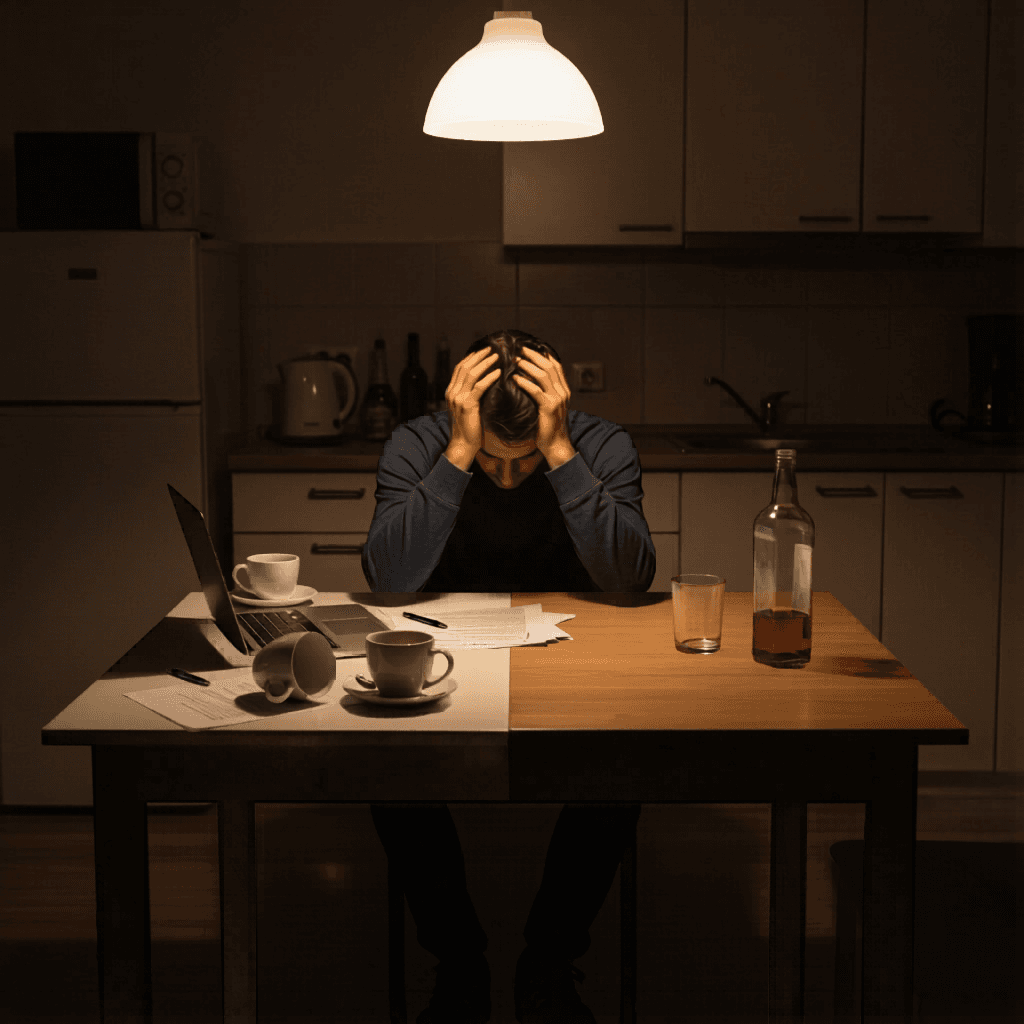
You're exhausted. Not the kind of tired that a weekend fixes—the kind that lives in your bones. You can't remember the last time you slept through the night without a drink first. Your motivation is gone. Your patience is gone. You're snapping at people you love and numbing out the second you're alone.
Is it burnout? Is it addiction? Or is it both feeding each other in a loop you can't seem to break?
Awkward Recovery is a Joint Commission Gold Seal accredited Intensive Outpatient Program (IOP) under Atomic Souls Counseling in South Austin, Texas. We see people walk through our doors every week asking this exact question. And the honest answer is that burnout and addiction aren't always separate problems—they're often two sides of the same messy coin.
They Look the Same Until They Don't.
Here's why this is so confusing: burnout and substance use disorder share a ridiculous number of symptoms. Exhaustion, irritability, brain fog, withdrawing from friends, declining performance, trouble sleeping, anxiety that won't quit. If you listed these out for ten of your coworkers, most of them would relate to at least half.
The [](https://www.who.int/)World Health Organization officially recognized burnout in 2019 as a syndrome caused by chronic workplace stress that hasn't been managed. What that definition misses is how often burnout becomes the gateway to dependency. You start drinking to manage the stress. It works—for a while. So you drink more. Eventually you need the drink to feel normal, not just to feel better.
Now you've got two problems instead of one, and each one is making the other worse.
The distinction matters because the solutions are different. Burnout alone might respond to boundaries, a job change, or finally taking that vacation you've been putting off. Addiction needs treatment. And when both are happening at the same time—which is way more common than people want to admit—you can't fix one while ignoring the other.
Key Takeaway: Burnout and addiction share overlapping symptoms that make self-diagnosis really hard, especially in work cultures that normalize both overwork and heavy drinking. They frequently show up together and reinforce each other, which means treating only one usually doesn't stick.
Signs It's Crossed a Line.
Everyone goes through stretches where they drink more than usual. Stressful project, bad breakup, hellish week—it happens. That's not necessarily a problem.
The shift happens when your drinking stops being connected to the stress. When the project ends but the nightly drinks don't. When you go on vacation and drink just as much—or more—without work as an excuse. When your tolerance has quietly climbed over the past year and you barely noticed.
Some specific things to pay attention to: you've set rules for yourself ("only on weekends," "only after 7 PM," "only two") and you keep breaking them. You're thinking about your evening drink during the middle of the day. You've tried to cut back and it was harder than you expected. You're drinking alone more than you used to. You need alcohol to fall asleep, to be social, to feel like yourself.
If you're in the service industry, you might be drinking or using harder substances during or right after every shift because the culture practically requires it. If you're in tech, those "beer and code" sessions might have gone from occasional to mandatory. If you're freelancing from home, the line between "afternoon break" and "afternoon drinking" has gotten blurry.
None of this makes you a failure. It means the thing that used to help has stopped helping and started creating its own problems. That's information, not a verdict.
Austin Makes This Especially Confusing.
Let's be honest about the city we live in. Austin's entire social ecosystem runs on alcohol. Happy hours, networking events, SXSW, ACL, every patio on South Congress, the bar you work at, the brewery your friend just opened. Drinking isn't just accepted here—it's practically a hobby.
According to [](https://www.samhsa.gov/)SAMHSA, high-stress environments with normalized substance use create significantly higher risk for dependency. Austin checks both boxes and then some.
And then there's remote work. When your office is your living room, nobody's counting your drinks. The natural accountability of being around coworkers—even imperfect accountability—disappears. The boundary between "work drink" and "home drink" dissolves when they happen in the same room.
Service industry folks have it especially rough. You're surrounded by alcohol every shift. Your coworkers drink during or after after close. Your social life is built around the bar scene. Recognizing a problem when everyone around you is doing the same thing feels almost impossible.
The point isn't that Austin is bad. It's that this city's culture makes it really easy to slide from "normal drinking" into something else without noticing—and really hard to see it clearly once you're in it.
Key Takeaway: Austin's culture normalizes heavy drinking across industries—from tech happy hours to service industry shift drinks to festival season. That environment makes it harder to recognize when drinking has shifted from social to dependent, and harder to address it without the right support.
What Happens When You Only Fix One.
Here's where people get stuck, and it's worth spelling out because this pattern plays out constantly.
Scenario one: you recognize the burnout and go after it. You negotiate better hours, set boundaries, take a mental health day, start meditating—all good moves. But you keep drinking the same amount because the habit has taken on a life of its own, separate from the stress that started it. Two months into your "burnout recovery," you feel better about work but your relationship with alcohol hasn't budged. Sometimes it's worse, because without the structure of intense work, there's more time and space to drink.
Scenario two: you try to cut back on drinking without addressing the burnout underneath it. You white-knuckle through sober evenings while returning to the same crushing schedule, the same anxiety, the same stress that drove you to drink in the first place. Without substances to numb it all, the burnout hits harder and faster. Relapse feels inevitable because the original problem is still right there, untouched.
The approach that actually works? Address both at the same time. An [](https://www.awkwardrecovery.com/intensive-outpatient-program/)IOP program like Awkward Recovery's treats substance use through evidence-based therapy while building the stress management, boundary-setting, and emotional regulation skills that keep burnout from spiraling back into drinking.
That's what dual diagnosis treatment actually means in practice—not a clinical buzzword, but the recognition that your mental health and your substance use are connected, and treating the whole picture is the only thing that actually holds up long-term.
Getting Help Without Blowing Up Your Life.
The most common thing we hear is some version of "I can't take time off." And for most working people, that's true. Shifts don't cover themselves. Deadlines don't wait. Bills don't stop.
That's exactly what IOP is for. [](https://www.awkwardrecovery.com/)Awkward Recovery runs evening sessions so you can work during the day and get treatment after hours. Your schedule stays intact. Your coworkers don't know.
Your boss doesn't know. HIPAA and 42 CFR Part 2 make sure of that—your treatment records are federally protected and invisible to employers, landlords, and background checks.
The program runs 12 weeks and includes group therapy with people who understand what it's like to hold down a job while dealing with this, individual counseling, and approaches like CBT and DBT that give you concrete tools—not platitudes. You can read more about what the program looks like week to week.
And the community piece matters. This isn't a sterile waiting room with fluorescent lights and clipboards. It's a room full of people in Austin who are doing the awkward, messy, honest work of figuring this out.
Key Takeaway: IOP lets you address both burnout and addiction without putting your life on hold. Evening scheduling, federal privacy protections, and a community that gets Austin's specific pressures make treatment something you can actually do—not just think about.
You Already Know Something Needs to Change.
You've probably been sitting with this for a while. Running the mental math, weighing the pros and cons, telling yourself you'll deal with it after this project, this season, this quarter.
The thing about burnout and addiction together is that they don't get better with time. They get worse. And the longer you wait, the harder both become to untangle.
You don't have to have it all figured out. You just have to be willing to have a conversation.
Call (512) 616-0809. It's confidential, it's free, and it's just a conversation. No commitment, no records sent anywhere, no one calling your job.
Reach out when you're ready—no pressure, no judgment.
Frequently Asked Questions.
Q: How do I know if it's burnout or addiction?
A: The biggest clue is whether your drinking changes when the stress does. If you drink less during easy weeks and more during hard ones, that's stress-driven. If you're drinking the same amount regardless of what's happening at work—or if you've tried to cut back and couldn't—that points toward dependency. A confidential assessment can help you sort it out without any commitment.
Q: Can I do this while working full-time?
A: That's literally what IOP is designed for. Evening sessions mean you keep your work schedule. Most people's coworkers have no idea they're in treatment.
Q: What if burnout is the real problem and I'm just drinking to cope?
A: Even if burnout started it, the drinking pattern may have developed its own momentum. Effective treatment addresses both at the same time—building better stress management skills while also working on the substance use. That way you're not fixing one thing just to have the other pull you back.
Q: Will my job find out?
A: No. Addiction treatment records are federally protected under HIPAA and 42 CFR Part 2. We never contact your employer without your explicit written permission. This stays between you and your treatment team.
Q: Is this a willpower thing? Can I just stop on my own?
A: Addiction involves real changes in brain chemistry and neural pathways—it's not a discipline problem. The same way you wouldn't push through a torn ACL by "trying harder," substance use disorder responds to structured, evidence-based treatment. That's not a weakness. That's how it works.
Q: What if I work in the service industry and drinking is part of the culture?
A: We hear this a lot. When your workplace is a bar and your social life revolves around drinking, getting sober feels impossible. It's not—but it does require building new tools and support systems that account for your specific environment. That's exactly what IOP helps with.
Q: How long is the program?
A: 12 weeks, with evening sessions three to five days per week. The timeline is based on your progress and needs, not a rigid formula.
Q: I've never done therapy. What's it actually like?
A: A little awkward at first—which, hey, that's kind of our thing. But after a session or two, most people say it feels less like "therapy" and more like having real conversations with people who actually understand what you're dealing with. No clipboards. No judgment. Just honest work with people who get it.

Rachel Stein.
For more than a decade, Rachel has walked alongside clients as a clinician — challenging when it matters and helping them build a life worth staying sober for. Trained in EMDR, DBT, and TF-CBT, she has built multiple intensive outpatient programs and curriculums from the ground up, and she leads the supervision structure that keeps the team accountable.
- EMDR, DBT & TF-CBT
- Addiction + co-occurring mental health
- IOP program design
- Trauma-informed practice
- LGBTQIA+ affirming care